



Navigating recovery after joint replacement surgery, a stroke, a severe cardiac event, or progressive mobility challenges quickly leads to a critical healthcare crossroads: Should you receive rehabilitation services at an outpatient physical therapy clinic or through in-home physical therapy?
Selecting the appropriate rehabilitation setting is not merely a matter of convenience. It can directly influence how rapidly you regain independence, your risk of hospital readmission, your overall out-of-pocket medical costs, and your long-term functional mobility.
Both settings utilize fully licensed, evidence-based Physical Therapists (PTs), Occupational Therapists (OTs), and Speech-Language Pathologists (SLPs). However, their delivery frameworks, clinical environments, and operational goals differ significantly.
Key Takeaway: Setting Dictates Success
Matching your current level of functional independence, transportation capabilities, caregiver support, and specific medical goals to the right rehabilitation environment can drastically improve clinical outcomes and patient retention.
To help you compare these rehabilitation options and make an informed decision, the following sections explain the different care models, clinical evidence, costs, insurance coverage, and key factors to consider when choosing between in-home and outpatient therapy.
1. Defining the Core Care Models
To make an informed choice, you must first understand the structural and logistical differences between in-home care models and traditional facility-based outpatient clinics.
Understanding In-Home Rehabilitation
In-home therapy delivers skilled care directly to the patient’s residence. However, in-home care is divided into two distinct administrative and clinical categories.
Traditional Home Health Care, Medicare Part A
Traditional home health care is designed specifically for patients who are medically classified as “homebound.” To qualify, leaving the home must require considerable and taxing effort, usually involving a supportive device such as a walker, wheelchair, or cane, or personal assistance from another individual.
Home health therapy is frequently bundled with skilled nursing care, home health aides, and medical social work.
Mobile Outpatient In-Home Therapy, Medicare Part B or Private Insurance
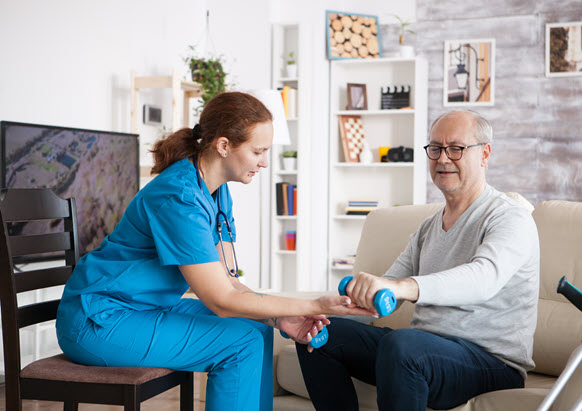
Mobile outpatient in-home therapy is a modern care model in which licensed outpatient therapists travel to the patient’s home to deliver standard one-on-one outpatient physical therapy.
Patients do not need to be homebound to receive this type of care. This model bridges the gap for individuals who have transportation barriers or simply prefer recovering in their personal environment.
Understanding Outpatient Clinical Therapy
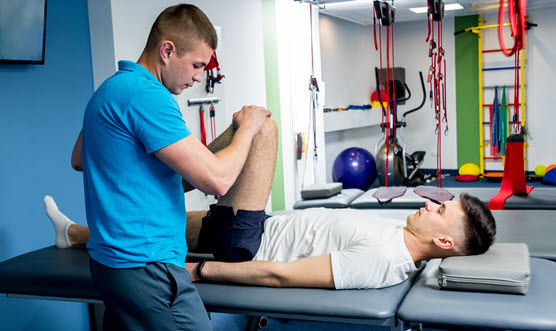
Outpatient physical therapy takes place inside a specialized medical center, orthopedic clinic, hospital-affiliated facility, or private sports medicine office. Patients typically travel to the facility two to three times per week.
Outpatient clinics are equipped with extensive commercial gym machinery, multi-height treatment tables, balance-tracking systems, and, in some cases, specialized hydrotherapy pools.
2. Comparing In-Home and Outpatient Therapy
Although both options provide professional rehabilitation services, the clinical focus, available equipment, transportation requirements, and treatment environment can vary considerably.
Primary Clinical Focus
In-home therapy typically focuses on activities of daily living, also known as ADLs. Treatment may include home safety, bed and chair transfers, basic balance, and the practical movements needed to function safely inside the home.
Outpatient clinic therapy often focuses on peak muscle performance, heavier resistance training, higher-level endurance, advanced gait training, and returning patients to physically demanding activities.
Equipment and Treatment Tools
In-home therapists use portable equipment such as resistance bands, light dumbbells, balance pads, and other compact therapeutic tools. They also incorporate the patient’s actual stairs, furniture, bathrooms, and living spaces into the treatment plan.
Outpatient clinics provide access to larger and more advanced equipment, including leg presses, cable columns, AlterG anti-gravity treadmills, aquatic therapy pools, and specialized balance systems.
Travel and Logistics
In-home therapy requires no travel because the therapist arrives directly at the patient’s front door.
Outpatient therapy requires the patient to drive, walk, or arrange transportation for each appointment. This can become challenging for patients with mobility limitations, driving restrictions, pain, or limited caregiver support.
Session Dynamics
In-home therapy generally provides dedicated one-on-one attention for the entire 45- to 60-minute visit.
Outpatient clinic appointments may also last 45 to 60 minutes, but the therapist’s attention may be divided among two or three patients, often with support from physical therapy aides.
Hospital Readmission Impact
In-home rehabilitation has been associated with a 28% reduction in 30-day hospital readmissions. Because the therapist sees the patient’s actual home environment, they may be able to identify medical complications, mobility limitations, and safety concerns before these issues result in an emergency room visit.
Outpatient therapy follows a more standard risk profile and requires patients and caregivers to monitor potential complications at home between appointments.
Environmental Realism
In-home therapists evaluate real household hazards such as plush rugs, narrow doorways, slippery tub thresholds, steep stairs, and difficult furniture arrangements.
Outpatient clinics use simulated environments, including standard wooden stairs, artificial obstacles, and smooth treatment floors. These tools are valuable, but they may not replicate the specific challenges a patient faces at home.
3. Clinical Evidence and Healthcare Statistics
Decades of healthcare outcome tracking demonstrate that home-based rehabilitation can produce clinical outcomes equivalent to, and in some areas superior to, traditional outpatient clinic visits for specific patient populations.
Hospital Readmission Reduction: 28% Lower
A landmark trial evaluating mobile outpatient physical therapy models found that patients receiving physical therapy in their homes after discharge experienced a 28% lower 30-day hospital readmission rate compared with patients referred directly to outpatient clinics.
In-home physical therapists can act as early-warning detectors by identifying surgical-site infections, medication errors, and serious fall hazards before these problems escalate into emergency room visits.
Equivalent Clinical Outcomes for Total Joint Replacements
A systematic meta-analysis published in the Journal of Orthopedic Surgery and Research analyzed clinical metrics between home-based rehabilitation and outpatient clinical therapy following total knee arthroplasty, or TKA, and total hip arthroplasty, or THA.
The metrics included range of motion, pain scores, and Western Ontario and McMaster Universities Osteoarthritis Index, or WOMAC, scores.
The findings included:
- Range of motion: There was no statistically significant difference at six weeks, three months, or 12 months after surgery.
- Pain management: Patients experienced identical pain-reduction trajectories across both care settings.
- Episode cost: In-home therapy achieved these clinical outcomes at a substantially lower total cost per episode of care by reducing emergency visits and transportation logistics.
Overcoming Attendance Barriers
National healthcare studies consistently show that transportation barriers contribute to up to 30% of missed medical and therapy appointments nationwide.
Missed appointments can lead directly to functional regression, reduced adherence to exercise protocols, and prolonged recovery timelines. In-home therapy models eliminate transportation friction entirely.
4. Key Decision Factors: How to Choose
When evaluating which care setting fits your immediate needs, consider the following clinical criteria.
When to Choose In-Home Therapy:
- Severe Early Mobility Limitations - If navigating stairs, transferring into a vehicle, or standing for more than five minutes causes severe pain or creates a fall risk, in-home therapy can provide a safe bridge during the early stages of recovery.
- Home-Specific Safety Hazards - If your recovery involves overcoming high-risk household barriers such as multistory stairs, steep entry ramps, narrow bathroom doorways, or living alone, in-home physical therapy can focus directly on your actual living environment.
- Cognitive or Neurological Diagnoses - Patients recovering from a stroke, traumatic brain injury, Parkinson’s disease, or dementia may thrive in familiar surroundings with lower levels of sensory overstimulation.
- Caregiver Integration - In-home therapy allows physical therapists to directly train spouses, children, or aides in safe body mechanics, bed mobility assistance, transfer techniques, and home exercise oversight.
When to Choose Outpatient Clinic Therapy:
- Advanced Resistance and Machinery Needs - An outpatient clinic may be the better choice if your recovery requires targeted quadriceps strengthening on a leg press, anti-gravity treadmill training using an AlterG system, or advanced balance-platform work.
- High-Performance and Athletic Goals - Outpatient therapy is often ideal for athletes and active individuals who want to return to sports, heavy lifting, or physically demanding trades that require high-impact testing.
- Peer Support and Social Engagement - The clinic environment can offer psychological benefits. Exercising alongside peers who are facing similar rehabilitation challenges may help boost morale and treatment compliance.
- Multidisciplinary Scheduling - Facilities may allow patients to schedule physical, occupational, and speech therapy appointments back-to-back during a single visit.
5. Insurance and Out-of-Pocket Cost Analysis
Understanding how insurance coverage works can help prevent unexpected out-of-pocket medical bills.
Medicare Part A: Home Health Benefit
If a physician certifies that you are homebound and require skilled therapy, Medicare Part A covers qualifying in-home physical therapy at 100% with a $0 copayment.
Deductibles may apply to the initial hospital stay, but covered home health services carry no coinsurance.
Medicare Part B: Outpatient Services in a Clinic or at Home
Medicare Part B covers standard outpatient therapy, whether it is delivered inside a clinic or through a mobile in-home therapist.
After you meet your annual Part B deductible, Medicare generally pays 80%, leaving a 20% coinsurance requirement. This remaining amount is frequently covered by a Medigap secondary insurance plan.
Referrals From Our Healthcare Partners
We receive patient referrals from respected healthcare organizations throughout New Jersey, including Atlantic Health System, Summit Health, Hackensack Meridian Health, Holy Name Medical Center, and RWJBarnabas Health. These organizations may refer patients who could benefit from our team’s outpatient homecare services.
Referrals may come from physicians, hospital discharge planners, case managers, care coordinators, and other healthcare professionals who recognize that a patient needs continued rehabilitation but may have difficulty traveling to a traditional outpatient clinic. Our mobile care model allows patients to receive skilled, one-on-one therapy in the comfort and familiarity of their homes.
Our team works closely with referring healthcare professionals to help provide continuity of care following hospitalization, surgery, illness, or injury. Each treatment plan is customized to the patient’s condition, home environment, mobility challenges, and recovery goals, with an emphasis on improving strength, safety, independence, and overall quality of life.
Commercial or Private Health Insurance
Private insurance companies typically charge fixed copayments for outpatient clinic visits. These copayments may range from $20 to $75 per session.
In-home care covered by private insurance may require preauthorization or clinical documentation demonstrating medical necessity.
6. The Sequential Hybrid Continuum
Recovery is rarely an all-or-nothing choice. The most effective clinical strategy often involves a progressive, multistage hybrid care model.
Phase 1: In-Home Rehabilitation, Weeks 1–3 After Surgery
The first phase focuses on wound safety, basic mobility, pain management, fall prevention, and modifications to the home environment.
Phase 2: Transition to an Outpatient Clinic, Weeks 4–8 and Beyond
Once the patient receives driving clearance and develops sufficient strength and stamina, treatment can transition to an outpatient facility. This allows the patient to use leg presses, endurance machines, advanced balance equipment, and other specialized rehabilitation technology.
Phase 3: Independent Maintenance
The final phase involves graduating to a customized home exercise program or using a community wellness center for long-term strength, mobility, and functional maintenance.
Ultimately, choosing between in-home physical therapy and outpatient rehabilitation depends on your current mobility, medical needs, transportation access, home environment, insurance coverage, and long-term recovery goals. In-home therapy provides personalized care, improved safety, and practical training within your actual living environment, while outpatient therapy offers specialized equipment and advanced strengthening opportunities. For many patients, a hybrid approach that begins at home and gradually transitions to an outpatient clinic provides the safest and most effective path toward greater strength, independence, and lasting mobility.
Frequently Asked Questions
1. Question: Is in-home physical therapy less effective because there is less heavy equipment?
Answer: No. For the overwhelming majority of post-surgical, neurological, and balance patients, bodyweight exercises, resistance bands, balance foam, and home steps provide more than enough challenge.
Clinical studies confirm that range of motion and functional recovery following major joint replacement procedures are comparable between in-home and clinic-based care.
2. Question: Do I need to be completely bedridden to qualify for in-home therapy?
Answer: No. To qualify under Medicare Part A home health, you must meet the definition of homebound. This means leaving the home requires considerable and taxing effort, often with the help of a supportive device or another person.
Under Medicare Part B mobile outpatient therapy, you do not need to be homebound. Licensed therapists can deliver standard outpatient care directly in your living room.
3. Question: How do session durations compare between in-home and clinic visits?
Answer: In-home sessions generally provide 45 to 60 minutes of uninterrupted, dedicated, one-on-one care with a licensed therapist.
Outpatient clinic appointments also commonly last 45 to 60 minutes, but a therapist’s attention may be divided among two or three patients simultaneously, with support from physical therapy aides.
4. Question: Can I transition from in-home therapy to an outpatient clinic later in my recovery?
Answer: Yes. In fact, this is considered the gold-standard continuum of care for many patients.
Patients frequently begin their recovery at home for greater safety during the early healing period. They can then transition to an outpatient clinic once they become more mobile and are cleared to drive, allowing them to begin higher-intensity resistance and endurance training.
5. Question: Is in-home physical therapy significantly more expensive out-of-pocket?
Answer: Not typically. Under Medicare Part A home health, qualified patients pay $0 out-of-pocket for covered services.
Under Medicare Part B or many commercial insurance plans, standard copayments or 20% coinsurance may apply to both clinic-based and mobile in-home visits. In-home care can also save patients substantial transportation, gasoline, toll, and parking expenses.
Choosing the Right Rehabilitation Setting
The right rehabilitation setting depends on your health, mobility, transportation options, living environment, insurance coverage, and long-term recovery goals.
In-home physical therapy can be an excellent choice during the early stages of recovery, especially when leaving the house is difficult, painful, or unsafe. It also allows your therapist to evaluate the real obstacles you encounter every day and develop a treatment plan around your home, routines, and personal needs.
Outpatient therapy may become more beneficial as your strength and mobility improve. A clinic provides access to advanced rehabilitation equipment, heavier resistance training, and higher-level exercises for patients returning to work, sports, or physically demanding activities.
For many patients, the best solution is a combination of both. Beginning with in-home therapy and transitioning to an outpatient clinic can provide a safe, gradual path from basic mobility to greater strength, independence, and long-term function.
Contact Us
If you or a loved one is recovering from surgery, a stroke, a cardiac event, or a condition affecting mobility, our rehabilitation professionals are here to help.
We can evaluate your current abilities, discuss your recovery goals, and help determine whether in-home physical therapy, outpatient rehabilitation, or a combination of both is the right choice for you.
Contact us today to learn more about our rehabilitation services or to schedule an initial evaluation.